How Ten Minutes Daily Can Transform Your SelfDiscipline
28 min read Discover how a focused ten-minute daily practice builds self-discipline through micro-wins, habit cues, and measurable progress—backed by examples, simple frameworks, and evidence-based tips. (0 Reviews)
Ten minutes is smaller than a coffee break, shorter than a news podcast, and easy to promise yourself you’ll do tomorrow. Yet, treat it as a deliberate daily investment and you’ll watch it compound into stronger self-discipline, measurable progress, and a calmer, more dependable you. This article is a practical playbook for using ten minutes a day to rewire your behavior, with specific routines, science-backed tactics, and examples that prove small is not just beautiful—it’s transformational.
Why Ten Minutes Works: The Psychology and Neuroscience
Ten minutes works because it trims away the two biggest reasons people don’t follow through: high friction and unclear payoff. What you’re aiming to build isn’t a single heroic effort; it’s a dependable identity—“I am someone who shows up.” Here’s why the tiny-but-daily approach outperforms big, sporadic efforts:
- Low friction, high frequency: Setting a 10-minute target cuts through procrastination. Ten minutes is below your brain’s resistance threshold, so it’s easy to start. Frequency accelerates habit formation by reinforcing the cue–routine–reward loop in the basal ganglia.
- Predictable reward loop: Reliable, quick wins train your dopamine system to expect a reward after a short, repeatable effort. That expectation makes tomorrow’s start easier. The dopamine hit isn’t about pleasure; it’s about learning what to repeat.
- Prefrontal protection: Self-discipline lives largely in the prefrontal cortex—the region that manages planning and impulse control. Micro-commitments reduce cognitive load, preserving self-control for consistency rather than draining it on long sessions.
- Compounding skill: Ten minutes of focused, deliberate practice moves the needle more than an hour of distracted effort. Repetition with feedback strengthens neural connections (synaptic efficiency) and builds automaticity.
Behavioral science supports this. Implementation intentions—“If it’s 6:30 a.m., then I lace my shoes”—double your odds of follow-through by pre-deciding what to do in context. Tiny Habits research (B. J. Fogg) shows that emotions and easy wins wire habits fast. And WOOP (Wish, Outcome, Obstacle, Plan) helps you prepare for resistance before it shows up. Together, these methods make ten minutes a powerful, repeatable lever.
The Ten-Minute Rule: A Simple Framework You Can Trust

The Ten-Minute Rule is a four-step loop you can apply to any goal:
- Pick the exact behavior. One verb. One location. One time. Example: “At 8:00 p.m. at my kitchen table, I will plan tomorrow in my notebook.”
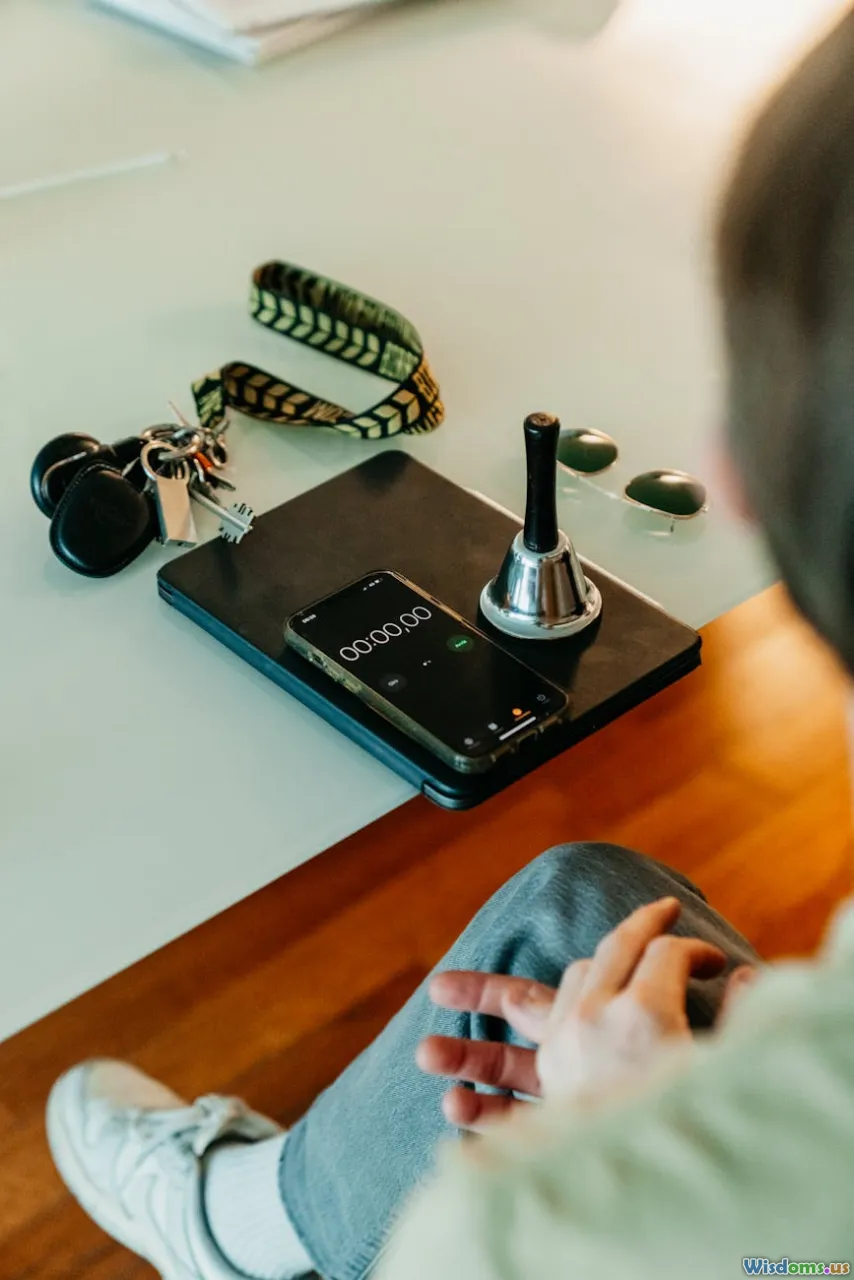
- Set a visible timer for 10 minutes. Make the finish line concrete. Seeing the countdown keeps you honest and encourages deep focus.
- Stop when the timer ends. This sounds counterintuitive, but stopping preserves freshness, limits dread, and builds craving to return tomorrow.
- Log a micro-metric. Record one number tied to the behavior (words written, pages read, reps completed, transactions categorized). Numbers turn effort into evidence.
Over time, this loop converts discipline from a moral struggle into a routine system. Your attention becomes a thing you can steer, not a force that steers you.
Design Your Daily Ten: A Quick Setup That Beats Willpower

Use this 15-minute setup once, then tweak as you go:
- Choose your target domain: health, learning, career, relationships, finances, or environment. Don’t pick more than two to start.
- Define a minimum viable win: “Walk to the end of the block,” “Write 50 words,” “Track one expense,” “Stretch hamstrings,” “Review 10 flashcards.”
- Anchor to an existing routine: Attach your ten minutes to a reliable cue—after brushing your teeth, after lunch, before opening email.
- Remove friction: Lay out shoes, open the document, preload the playlist, keep the notebook on the pillow. If it takes over 20 seconds to start, you’ll stall.
- Precommit: Tell a person who cares about your progress. Place a $10 bet with a friend you’ll do your ten minutes daily for two weeks.
- Track publicly (even if just for you): A wall calendar with X’s, a habit app, or a visible sticky note. Make success visible.
Sample If–Then card you can copy:
- If it’s 7:10 a.m., then I start a 10-minute timer and do breath-focused meditation.
- If I miss my morning window, then I do it immediately after lunch.
- If I miss both, I perform a 2-minute “do something” version (five deep breaths + one minute of silence + three gratitude notes).
12 Ten-Minute Protocols Across Life Domains

Below are proven, practical mini-routines. Each one is specific, measurable, and designed for quick wins that stack.
- Strength Micro-Circuit (fitness)
- Set a 10-minute timer.
- Do a ladder of push-ups, air squats, and plank holds: 8 push-ups, 16 squats, 30-second plank. Repeat as many rounds as you can with good form.
- Track total reps or rounds. Aim to increase by 1–2 reps per week.
- Why it works: Whole-body compound moves, no equipment, progressive overload by reps not time. Ten minutes of daily movement counters sedentary time and builds an identity as someone who trains.
- Mobility Reset (health and longevity)
- Two minutes ankle and hip circles, two minutes thoracic rotations, two minutes hamstring flossing, two minutes hip flexor stretch, two minutes shoulder dislocates with a band or towel.
- Track pain-free range of motion and posture feels. Note activities that feel easier (e.g., standing up after sitting, climbing stairs).
- Box Breathing + Journaling (stress and focus)
- Four minutes box breathing (inhale 4, hold 4, exhale 4, hold 4), then six minutes of “What matters most today?” journaling.
- Track a 1–10 calm score and identify a single priority you’ll protect.
- Why it works: Breath regulates autonomic arousal; journaling reduces rumination and clarifies action.
- Draft 150 Words (creative output)
- Open the document, start timer, and write 150 raw words. No backspace. End mid-sentence to make the next day easier.
- Track word count and days in a row. Stable 150-word sessions equal roughly one short article per week.
- Spaced Repetition Sprints (learning)
- Use Anki or another flashcard app. Do reviews only; add new cards sparingly.
- Track cards reviewed and retention rate. Ten minutes a day can keep hundreds of facts alive in long-term memory.
- Language Shadowing (skill)
- Pick a 2–3 minute audio clip from native speakers (podcast, YouTube). Listen once, then shadow—repeat with them—for the remainder.
- Track clips completed and words you can now pronounce correctly. This accelerates accent and cadence.
- Micro-Clean (environment)
- Choose the “launchpad” zone (desk, dining table, entryway). Ten-minute tidy: remove, sort, wipe, reset.
- Track a daily “clear surface” score (0–2). Clutter-free surfaces reduce decision fatigue and invite focus.
- Budget Pulse (finances)
- Open your bank app and categorize transactions since yesterday. Move money to a labeled sub-account: “Future Fun,” “Emergency,” “Rent.”
- Track daily spend and savings rate. Ten minutes prevents drift and panic.
- Relationship Ping (connection)
- Send one meaningful message: gratitude, check-in, or “this made me think of you.”
- Track touches per week. Relationships improve when you move from “someday” to “today.”
- Read 8 Pages (knowledge)
- Choose a single book. Read 8–10 pages. Mark one idea to apply today.
- Track pages and ideas applied. At 8 pages/day, you’ll finish ~1–2 books per month.
- Career Capital Builder (work)
- Ten minutes improving a skill your market values: writing a tighter sales email, refactoring one function, sketching one UI, practicing one interview question.
- Track a weekly portfolio artifact or measurable improvement.
- Night Audit (systems)
- Three lines: What went well, what didn’t, one tweak for tomorrow. Then lay out clothes, prep breakfast, stage your tools.
- Track consistency. Morning you will thank night you endlessly.
From Micro to Meaningful: Turning Minutes into Metrics

When you measure, you multiply. Ten minutes becomes transformative when you turn it into numbers you can steer. Use these simple metrics:
- Binary streak: Did I show up? Yes/No. Aim for “chains,” not perfection. If you miss, start a new chain immediately.
- Volume: Words written, reps done, pages read, dollars saved. Choose one per behavior.
- Rate: Words per minute, reps per minute, dollars saved per day. Useful for spotting plateaus.
- Leading indicator: Number of job pitches sent, flashcards reviewed, workouts started. This is controllable.
- Lagging indicator: Weight, money saved in 90 days, reading level, output quality. This moves slower; don’t obsess daily.
Concrete examples of compounding:
- Reading: 10 minutes/day at ~250 words/minute = 2,500 words, or ~9 pages. Over 300 days, that’s ~2,700 pages—about 8–10 nonfiction books.
- Writing: 150 words/day x 300 days = 45,000 words—draft length of a short nonfiction book or a year’s worth of articles.
- Fitness: 60 air squats/day x 300 days = 18,000 squats—massive endurance gains with zero equipment.
- Savings: $5/day auto-transfer x 300 days = $1,500 plus interest. Pair with a 10-minute budget pulse and you’ll avoid most “surprise” fees.
Create a weekly snapshot (10 minutes on Sunday):
- Effort: How many days did I show up? (Goal: 5–7)
- Outcome: One number trend per habit
- Friction log: What tripped me up?
- Adjustment: One tweak (time, trigger, environment)
The Science (Without the Hype): How Self-Discipline Actually Builds

- Habit loops: Cue → routine → reward. The basal ganglia automates frequent behaviors; your job is to repeat the right loop often enough.
- Implementation intentions: Research led by Peter Gollwitzer shows that “If X, then Y” plans increase follow-through by specifying context.
- Tiny habits and emotion: B. J. Fogg’s model emphasizes that behaviors become sticky when they’re easy and emotionally celebrated. Ten minutes is easy; a fist pump seals the loop.
- WOOP: Gabriele Oettingen’s method adds mental contrast—imagine the outcome, then identify obstacles and a plan. It’s a practical antidote to wishful thinking.
- Ego depletion debate: Early studies suggested self-control is a limited resource. Replication attempts have been mixed, with newer models emphasizing motivation, strategy, and context over a single “tank” of willpower. Translation: design beats grind.
- Neuroplasticity: Repetition strengthens synaptic pathways. Short, consistent practice sessions are more effective for learning than long, inconsistent ones (spacing effect).
Nothing here requires extremes. The science favors small, repeatable inputs. Your identity updates every time you cast a vote with a ten-minute session.
Overcoming the Real Obstacles: Tired, Busy, Traveling

- Too tired: Do a “floor version.” If you’re exhausted, the win is the routine, not the volume. Example: one push-up, 60 seconds of journaling, three flashcards. Mark it as a save, not a fail.
- Too busy: Borrow time from low-value scrolls. Replace the first 10 minutes of social media with your routine. Set your phone to grayscale until you finish.
- Traveling: Have a travel kit: mini resistance band, one notebook, downloaded audio. Define three travel-safe protocols in advance.
- Sick: Switch to restorative protocols: breathing, gentle stretching, reading. Protect the streak without taxing your body.
- Boredom: Rotate a menu of 2–3 variants that still hit the same metric. Keep the structure, change the flavor.
- Disruption: Use an “if I miss the morning, then I do it before dinner” clause. Always have a second anchor.
Progressive Overload: Scaling Without Burning Out

Ten minutes is the floor, not the ceiling. How to scale intelligently:
- Add reps, not minutes: Keep the time fixed for predictability, increase the reps or difficulty within the window.
- Add precision: Better form, cleaner sentences, higher-quality inputs. Make the same ten minutes produce more value.
- Add days before adding duration: Go from 4 days/week to 6 days/week before going from 10 to 20 minutes.
- Use ladders: Week 1–2: 10 minutes. Week 3–4: 12 minutes. Week 5–6: 15 minutes. Maintain your streak at each level before advancing.
- Cycle intensity: 3 weeks build, 1 week deload. Keep the habit alive during deload with easier versions.
The 30-Day Ten-Minute Challenge Blueprint

You can dramatically change your self-discipline in a month by running this structured challenge. Keep a visible tracker.
-
Week 1 (Friction Killers):
- Day 1: Choose two habits and set up triggers and tools. Do the first ten-minute session for each.
- Day 2: Preload environments (lay out clothes, open docs). Practice stopping right at 10 minutes.
- Day 3: Write If–Then plans and a 2-minute fallback version.
- Day 4: Start a wall calendar; mark X’s.
- Day 5: Recruit an accountability partner; define check-in cadence.
- Day 6: Run a “busy day” drill—do both habits in compressed conditions.
- Day 7: Weekly review (10 minutes): log metrics, friction, one tweak.
-
Week 2 (Consistency Over Heroics):
- Aim for 6/7 days. Celebrate showing up.
- Add a micro-reward after each session: stand, stretch, smile, say “Done.”
- Keep volume conservative; avoid adding minutes.
-
Week 3 (Quality Upgrades):
- Introduce deliberate practice: pick one sub-skill per habit to refine (e.g., writing strong verbs, perfect squat depth).
- Replace low-quality inputs (doomscrolling) with supportive ones (reading or tutorials) for 10 minutes.
-
Week 4 (Identity and Scaling):
- One slight increase in difficulty (not time) for each habit.
- Write a one-paragraph “who I am becoming” note. Read it before your session.
- Final review: compare Day 1 to Day 28 metrics. Choose what to keep, iterate, or drop.
Expectations: You’ll miss a day. Your win is how quickly you return. The perfect month is not 30/30; it’s 28 days with two graceful recoveries.
Case Snapshots: What Changes in Ten Minutes
- The reluctant writer: A marketing manager commits to 10 minutes of writing before email. In six weeks, she has six blog drafts, a style guide, and lower inbox anxiety. Metrics: 160–220 words/day, 5 days/week.
- The overcommitted parent: He uses a nightly 10-minute “launchpad reset.” Mornings go from chaotic to smooth. Metrics: out-the-door time reduced by 12 minutes; forgotten items drop by 80%.
- The anxious student: Ten minutes of spaced repetition plus 10 minutes of breath-led journaling curb cram sessions. Grades improve not from cramming, but from memory maintenance. Metrics: daily review streak of 24 days; exam recall confidence up 2 points on a 10-point self-scale.
- The busy founder: She adds a 10-minute finance pulse. Over three months, cash flow surprises vanish; a small buffer grows to one month of expenses. Metrics: daily categorization + weekly forecast.
None of these people “found more willpower.” They installed better systems and started small enough to start every day.
Tools, Timers, and Environments That Make It Easy

- Timers: Physical kitchen timer or a simple phone timer. Visual countdowns reduce mind-wandering.
- Habit trackers: Any app you like or a wall calendar. If a tool takes longer than 30 seconds to update, switch tools.
- Environment design: Put the cue where your eyes land—book on pillow, shoes by door, dumbbell next to desk, notebook on keyboard.
- Phone hygiene: Do Not Disturb for 12 minutes; grayscale until you log your session; hide social apps on a second screen.
- Anchoring music: Use the same instrumental track for your ten-minute sessions. The song becomes a mental “on-switch.”
- Micro contracts: A sticky note that says, “At 7:30 p.m., I plan tomorrow for 10 minutes. If I miss, I do it before sleep.” Sign and date it.
Ten-Minute Rituals for Specific Roles

- For leaders: A “clarity sprint.” Ten minutes to write three priorities, one message to your team, and one blocker to remove. This aligns the day without meetings.
- For students: A two-part block—five minutes to skim syllabus or lecture notes, five minutes to test yourself on key points. Self-testing beats rereading for retention.
- For parents: Nightly reset—set out clothes, prep snacks, sign forms, and place everything by the door. It converts morning chaos into cruise control.
- For freelancers: Ten minutes of pipeline hygiene. Update leads, send one pitch, nudge one dormant prospect. Keeps revenue predictable.
- For athletes: Ten minutes of movement prep: mobility + activation. Reduces injury risk and makes workouts feel smoother.
Advanced Tactics: Make Discipline the Default

- Temptation bundling: Pair your 10-minute habit with something you crave. Example: only listen to your favorite playlist during mobility.
- Commitment devices: Website blockers, banking rules that auto-transfer savings, or a friend holding a refundable deposit contingent on your streak.
- Habit stacking: After coffee, I meditate. After meditation, I write one paragraph. After writing, I walk outside for two minutes. The chain reduces decision-making.
- Rehearsal: Mentally practice starting: see yourself setting the timer, opening the doc, writing the first sentence. Rehearsal makes starting feel familiar.
- Fresh starts: Use birthdays, Mondays, or month-ends to relaunch. Research shows “temporal landmarks” boost motivation to reset.
What If Ten Minutes Feels Too Small?

Common concerns:
- “It’s not enough to matter.” Revisit the metrics. Ten minutes daily outperforms a single 70-minute burst when it comes to habit formation and retention. In practice, ten minutes often grows once you’re consistent.
- “I’ll never get in the zone.” Flow likes momentum. The hardest part is starting. Ending mid-sentence or mid-rep primes your brain to re-enter quickly next time.
- “I keep overshooting the timer.” Great—just don’t rely on overshooting. The habit you’re building is showing up on time, not marathon sessions. Stop most days at 10 to maintain appetite.
- “I missed three days; I ruined my streak.” Start a new micro-streak today. Discipline isn’t broken by a miss; it’s built by the return.
A Practical Day-Plan Example You Can Adopt Today

Here’s a sample day with two 10-minute habits:
- Morning (7:10 a.m.): Breathing + One Big Thing journal entry.
- Start timer, do 4 cycles of box breathing, write your single must-do for the day, and list the first action. Log calm score and one-word theme.
- Evening (8:00 p.m.): Night audit + launchpad reset.
- Three lines: win, friction, tweak. Then set out clothes, prep bag, and clear one surface. Log a 0–2 clear-surface score.
If you’re adding a third, make it health-related (movement or mobility). Health supports everything else you want to do.
Your Ten-Minute Starter Menu (Pick Two)

- Write 150 words toward a project
- Read 8–10 pages non-fiction or high-quality fiction
- Breathwork + journal (4 + 6 minutes)
- Mobility reset (hips + shoulders)
- Spaced repetition review (flashcards)
- Budget pulse (categorize and plan one money move)
- Micro-clean the launchpad zone
- Language shadowing (2–3 minute clip; repeat)
- Relationship ping (one thoughtful message)
- Career capital (improve one sub-skill you get paid for)
Pick any two that support who you want to become. Start tonight or tomorrow morning.
The magic of ten minutes isn’t the minutes. It’s the promise you keep with yourself. When you show up for ten, you prove you can start and finish. That proof accumulates. A week in, you’ll have small progress. A month in, you’ll have momentum. Three months in, you won’t be asking whether ten minutes is enough—you’ll be using it to launch work that once felt out of reach.
Set a timer. Choose one action. Stop on time. Log the win. Then do it again tomorrow. That’s how ten minutes daily transforms your SelfDiscipline—quietly, steadily, and for good.
Rate the Post
User Reviews










Popular Posts