Blood Spatter Analysis Explained for Aspiring Detectives
16 min read Learn the basics of blood spatter analysis, essential techniques, and key patterns every aspiring detective should know. (0 Reviews)
Blood Spatter Analysis Explained for Aspiring Detectives
Few aspects of forensic science capture the imagination like the study of bloodstains. Television shows and documentaries have brought blood spatter analysis into the public eye, but they sometimes over-simplify or dramatize what's actually a highly scientific process. If you’re an aspiring detective, understanding the fundamentals—and complexities—of blood spatter analysis equips you not only with investigative tools, but also with critical thinking skills needed to uncover the stories that stain patterns reveal.
The Science Behind Blood Spatter Formation

Blood spatter, at its core, is governed by the laws of physics. When blood exits the body—whether by blunt force, sharp weapons, or gunshot—its behavior is dictated by the energy imparted and the properties of both the blood and the surface it contacts.
Fluid Dynamics at Play
Blood is a viscoelastic fluid; it behaves almost like thick syrup. When an external force acts on blood, it overcomes its cohesive forces, creating individual droplets. These droplets travel through the air, and why and how they land gives rise to the patterns analysts see at a scene.
For instance, a drop of blood falling vertically from a stationary source onto a flat surface creates a nearly circular stain. Change the height or angle, and the resulting pattern can inform an expert about movement, force, and position:
- Low-velocity spatters (under 1.5 m/s) – often created by passive dripping, resulting in larger, almost spherical stains.
- Medium-velocity spatters (1.5–7.5 m/s) – typically caused by blunt force trauma; the stains are smaller and more irregular.
- High-velocity spatters (over 30 m/s) – such as those from gunshots, lead to tiny droplets known as misting, which can indicate the shooting distance.
Example: Reconstructing the Scene
If an investigator finds wide, elongated stains on a wall with an obvious direction, it can point to a swing of an object—a bat, perhaps—used with considerable force. Larger droplets on the floor beneath suggest blood passively dripped from a wound before impact.
Types of Bloodstain Patterns
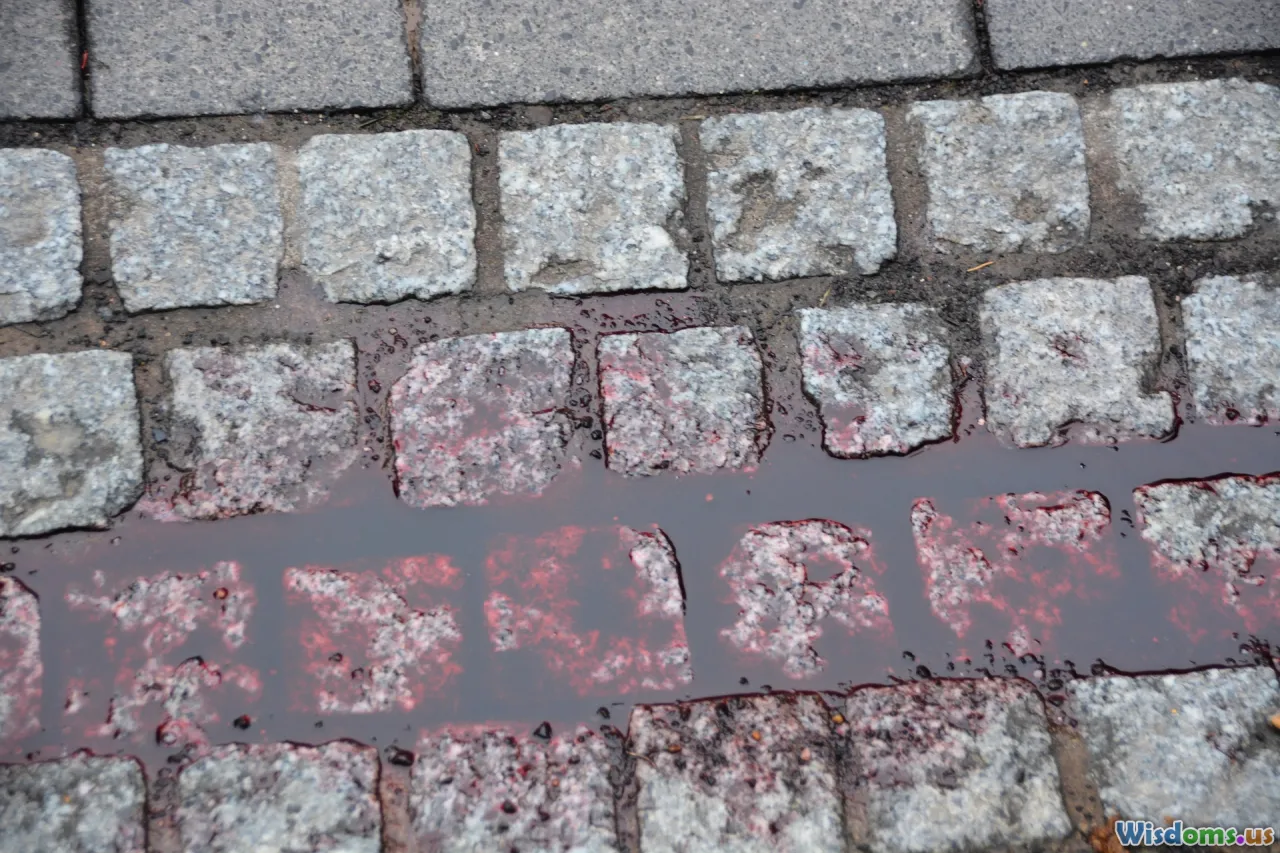
Interpreting bloodstains isn't just about measuring drops—it's knowing what to look for and distinguishing between various types of patterns that may overlap. Here are the most common bloodstain pattern groups and what they reveal:
Passive Stains
Formed by gravitational force alone, passive stains include drops, flows, and pools:
- Single drops: Can indicate position and movement—e.g., tracks from a limping victim.
- Patterns of pools or smears: Suggest where a victim paused or bled heavily over a period of time.
Transfer Stains
Happen when a bloody object touches a surface, leaving an imprint or swipe mark. For example, a bloody handprint can tell a story: Was the person seeking support? Were they dragged? The direction and clarity guide investigators.
Projected Stains
Created when force propels blood outward, as with arterial spurting or cast-off from weapons. The angle and distribution can indicate the number of blows or shots, location of the attacker, and even which hand was used in some cases.
Case Study: Investigators once reconstructed the sequence of attacks in an assault case using cast-off patterns on a ceiling—revealing the assailant repeatedly raised their weapon overall. Such details became critical to the case.
Spurts, Cast-off, and Misting: Telling Them Apart

To the untrained eye, spurting, cast-off, and misting may all seem like random spots. But forensics professionals know to spot the subtle distinctions, unlocking vital clues.
Arterial Spurts
Created by blood under pressure leaving a breached artery, these sprays often pulse, reflecting the victim’s heartbeat. Spurts arc outward in rhythmic, often V-shaped patterns unique from other stains.
- Example: Patterns found on furniture and walls can establish if and where major arteries were severed.
Cast-off Patterns
Formed as blood is flung from a moving object—like a bloodied knife or bat. Each swing leaves a line or arc of individual stains. The spacing, angle, and number of patterns can indicate the minimum number of swings.
- Analytical Tip: High arcs on the ceiling sometimes implicate the perpetrator's height or hand dominance when reconstructing events.
Misting
Produced in gunshot wounds, very high velocity fractures blood into a fog-like fine spray, typically less than 1 mm across. Not all misting necessarily implies a firearm—it can also result from powerful expulsions of breath or rapid movement, but proximity to the source is key evidence.
Tools and Techniques of Blood Spatter Analysis

Blood spatter analysis is a blend of fieldwork, experimentation, and mathematics. Here’s a breakdown of the common tools and the processes detectives employ to bring scientific rigor to every scene.
Common Tools
- Scale rulers: Essential for scaling stains in photographs and for precise measurement.
- Angle finders/protractors: For ascertaining the narrowest angle of elliptical stains.
- Luminol and Bluestar: Chemicals that reveal latent bloodstains invisible to the naked eye, glowing blue in response.
- Stringing kits: By stretching strings from individual stains back toward their origin, investigators can reconstruct the trajectory in three dimensions.
Digital Technologies
Emerging methods help modern detectives visualize and analyze scenes with greater accuracy:
- High-resolution photography and photogrammetry: Used to digitally celebrate blood patterns, allowing for detailed documentation and analysis long after the scene has been cleaned.
- 3D laser mapping: Maps whole rooms in fine detail, facilitating later experimental reconstruction.
- Simulation software: Physics engines input stain data and simulate potential events, adjusting for variables such as angle, speed, and obstacles.
Method in Action: Simple Angle of Impact Calculation
Analysts use trigonometry to find a droplet’s impact angle. The formula is:
angle = arcsin (width of stain / length of stain)
With this, and by measuring multiple stains, detectives can plot their origins, corroborating or challenging witness statements about "where everyone stood."
The Origin of Spatters: Finding the Point of Convergence
Determining the location from which blood originated—the so-called "point of convergence"—can make or break a case. Here’s how it’s approached:
Step-by-Step Convergence Process
- Outline several elongated stains on the surface. Their long axis indicates direction.
- Draw straight lines backward through the center of each stain. The intersection of these lines—the point of convergence—suggests the source’s horizontal location.
- In three-dimensional analysis, height comes next. By calculating the angle of drop impact (as previously described), and tracing backward in space, experts find the 'point of origin' in vertical space (e.g., weapon held over victim's head).
Practical Example
a. In a home invasion case, converging arcs on the wall suggested the attacker’s position exceeded previous estimations by over a meter. This allowed detectives to align a suspect’s height and reach with documented evidence, excluding a prior suspect and focusing investigation elsewhere.
Real-Life Applications: Blood Pattern Analysis in Action

The stakes are high in criminal investigations. Blood spatter can corroborate or disprove alibis, reveal movements and actions of participants, and provide critical detail to ambiguous testimonies. Here are a few historical examples:
Example 1: The Hae Min Lee Case
In the famed case chronicled by the "Serial" podcast, blood pattern information helped determine whether Lee had been moved post-mortem. Although DNA played the primary role, analysts examined potential blood transfer on fabric and in car carpeting, helping shape the timeline.
Example 2: The Sam Sheppard Case
Blood stains on walls and ceilings not only told of a violent assault, but their motion and axis contradicted the alleged sequence of events as described by Dr. Sheppard. Decades later, modern analysts employed sophisticated stringing and pattern analysis, fueling renewed debate about his guilt or innocence.
Example 3: The O.J. Simpson Trial
Arguably the most famous case involving blood pattern analysis, experts scrutinized spatter—especially on Simpson’s socks and car—to determine source direction, velocity, and transfer, sparking fierce courtroom debate over interpretation, contamination, and collection procedure.
Distinguishing Fact from Fiction: Pop Culture vs. Reality
Media depictions offer a romanticized and rapid version of blood spatter analysis. While they ignite interest, aspiring detectives should recognize the real-world discipline entails careful measurement, scientific validation, and frequently, testimony far more nuanced than what’s seen in an hour-long show.
Key Differences to Remember
- Time & Process: Real analyses can take weeks, requiring coordination with pathologists, coroner's reports, and lab results.
- Certainty: On TV, analysts make confident declarations. In reality, practitioners always work within probabilities and acknowledge margin for error.
- Complexity of Scenes: Actual crime scenes often have multiple overlapping patterns, surfaces, and interfering factors—each requiring isolation and in-depth study.
- Chain of Custody: Lab accuracy and documentation are paramount. Every sample must be properly recorded, maintained, and interpreted.
Remain analytical—never assume, and always corroborate bloodstain analysis with other physical, testimonial, or trace evidence.
Common Pitfalls and How to Avoid Them

Even skilled analysts and seasoned detectives can make missteps. Understanding the frequent errors guards against wrongful interpretation:
Misidentifying Stain Origin
Diffused or diluted stains (due to water, cleaning, or weathering) may obscure directionality or the point of origin. Counter this with meticulous measurement and, if possible, use of reagents to recover faded stains.
Contaminating the Scene
Premature movement of evidence, lack of PPE, and failure to cordon off scenes can corrupt bloodstain data, introducing artifacts or destroying original patterns.
Over-reliance on a Single Discipline
Bloodstain analysis rarely tells the full story alone; always seek supporting evidence from wound pathology, ballistics, or DNA typing.
Pro Tip :
Where visual cues are ambiguous, pair blood pattern findings with experimental reconstructions using synthetic blood—a staple in training forensic teams—under similar environmental conditions to those present at the scene.
Expanding Your Toolkit: Resources and Training Paths

For aspiring detectives, developing a robust skill set requires proactive study, hands-on training, and continued education. Here’s how to build expertise:
Formal Training
- Forensic science degrees (BSc, MSc): Foundational knowledge of biology, chemistry, and physics as applied to blood evidence.
- Specialized short courses: Agencies like the International Association of Bloodstain Pattern Analysts (IABPA) offer workshops for professionals and novices alike.
In-the-Field Practice
Participate in mock crime scenes, cadet challenges, and laboratory internships. These develop the muscle memory required for detailed reporting and courtroom testimony.
Literature & Case Studies
Study published casework and academic research. Renowned literature includes "Bloodstain Pattern Analysis With an Introduction to Crime Scene Reconstruction" by Tom Bevel.
Networking
Attend conferences and seminars, joining online forums for real-world advice and mentoring.
Final Thoughts: A Detective’s Eye for Truth

Blood spatter analysis is a powerful lens through which trained professionals turn drops and stains into a coherent narrative of events. For aspiring detectives, it demands discipline, objectivity, and a willingness to constantly study and question. Mastery of this science doesn’t just solve crimes—it honors the search for truth that lies behind every investigation. That critical, patient approach is what sets apart the most skilled and respected detectives.
Rate the Post
User Reviews





Popular Posts